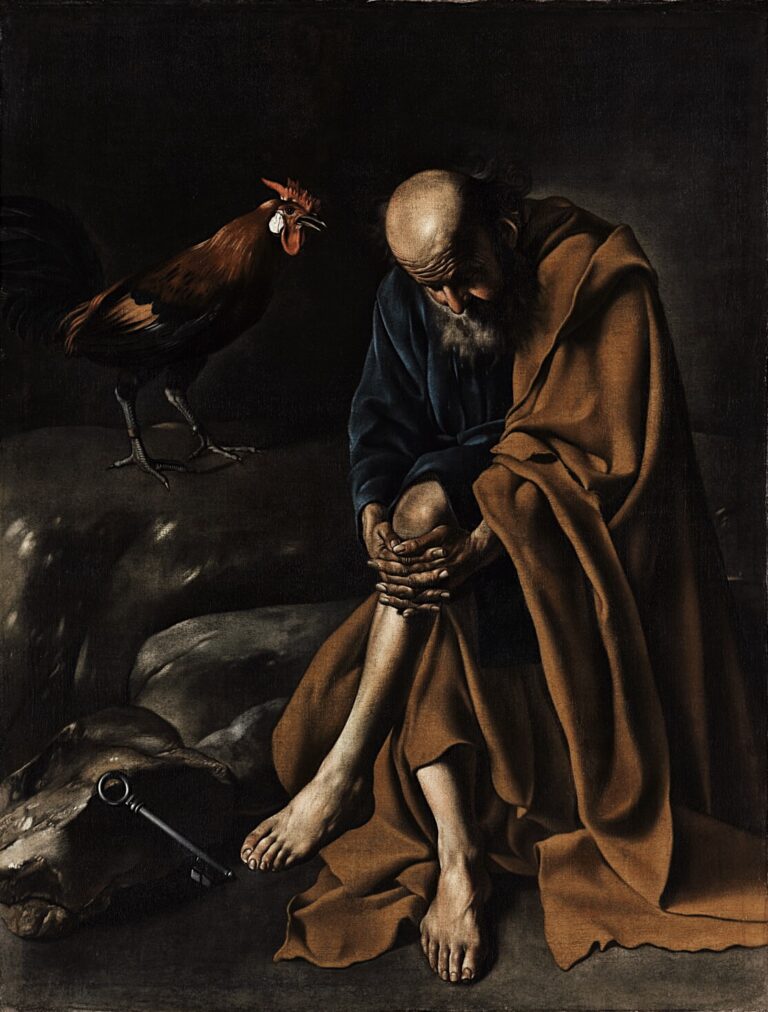
Here’s another one of my favourite paintings in the louvre. This one is titled, the tears of Saint Peter. Last week, I showed you an Italian painting with a similar name, but this one is by a Spanish painter, also from the baroque period.
Now what I love about these baroque paintings, is how it immediately draws your attention to the main subject, they’re very to the point, especially those painted in this chiaroscuro style, which literally translates into, light and dark, as you can see here from the heavy contrast.
But even with the seemingly simple composition of these paintings, the beauty of them is that, just like photographs, paintings have the ability to tell a thousand words, and as a painter, you have full control over it, and that allows these paintings to be packed full of subtle and purposeful details, that tell you more than words ever could.
So let’s dive into this. Again, just like photographs, paintings have the ability to freeze a very specific moment in time. So what is going on right now?
Here we have a repentant Peter, looking very sorrowful after having done a triple denial of his lord and saviour Jesus Christ.
And I just love how imaginative artists were to interpret these extra biblical moments, and yet packing in so much of the gospel.
And the theme of this painting I believe, revolves around the idea of, take up your cross, and follow me. Or in this case, your key.
Let me explain.
First, let’s take a look at Peter’s forehead. Just like the previous painting, the stress of this betrayal is extremely intricately detailed. But here’s something to remember. As per this moment in time, Peter is by no means an old man. If Christ was about 30, then he must’ve been about that age as well. And my bru does not look 30.
And if we take at his face, you’ll notice that even though the painting is titled, the tears of Saint Peter, he’s got no tears. Unlike the painting from last week, this Saint Peter has got no tears left.
All these details point to one thing.
That Peter’s been sitting here moping about in self pity for quite a long time now.
That said, the artist is making quite an effort here to show us that he is truly repentant.
Besides his head bowed down low, we can see that his entire demeanour is geared towards making himself as small as possible, a similar idea to how we prostrate ourselves before the blessed sacrament in adoration. If we look at his fingers, they’re tightly clasped together, even his toes are clasped together, overlapping, almost as though to take up less space, as he crosses his legs together, squeezing them in towards himself with his hands.
This is almost as close as we can get to being curled up into a ball, without being curling up into a ball.
And I love how the artist chooses to portray him in this specific position, because it’s easy to relate to if we just think about how we’ve felt when we have found ourselves sitting like this.
And unlike in the other painting, this Saint Peter is actually turned towards the light, facing God and the reality of his sin, rather than hiding. He’s even almost got a slight glow about him, almost a prefiguration of his Halo, which he doesn’t have yet in this painting.
This is the look of someone who is truly repentant. Truly humbled before the Lord in acknowledgement of his sins, almost a personification of John 3:30, he must increase, I must decrease.
So why then, has he still been sitting here for so long? We even see his key placed to the side, a symbol of his responsibilities as the vicar of Christ.
And to drive the point home even further, he’s quite literally surrounded by the symbols of his mission, to be the rock upon which the Church is built.
The answer I believe, lies in the cock.
Let’s now draw our focus to the secondary subject of this painting, the infamous cock.
Upon first glance, anyone would be able to identify the taunting expression of this bird, which is quite an accomplishment for an artist, portraying human expressions with such a usually soulless and expressionless animal without it looking cartoonish. And if we look at its body posture, it is extremely juxtaposed to peter’s humble demeanour, with its legs spread wide, in an extremely antagonising stance, taunting Peter for his sins.
But this is exactly what seems to be holding Saint Peter back from picking up his key and fulfilling his mission as leader of the earthly Kingdom of God.
Because this, is not the voice of God.
The voices that continue to shame you even when you have truly repented, that comes from a much darker place.
And for all the pomp and taunting of this rooster, one detail you might miss, is that this bird actually has a ring on its leg, meaning that at the end of the day, this cocky bird, pun intended, is just a worthless farm animal, with zero authority, not at all worth listening to.
So here’s my interpretation of this painting.
We’ve all got some sort of cock, a voice in our head that keeps shaming us for our sins, holding us back from receiving the boundless mercy of God, even when we’ve already turned to face the light.
So moral of the story, stop listening to your cock. Go to confession. Pick up your keys. And go live your mission.